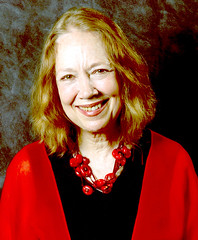
Liz Gorrill | Dreamflight | NA1010

The final “Dream Sequence” begins with a piece entitled “Blues From A Subterranean Galaxy,” which, without a hint of Sun Ra’s leavening humour, should give a sense of what’s going on here: just imagine space converted to mass. What is remarkable, however, is what Gorrill achieves by the end of the sequence. The final “Deep Awakening,” along with numerous other moments in the performance, has such kinetic energy that it levetates not only itself but the burdens of history, particularly piano history, that Gorrill so willingly assumes elsewhere. — Stuart Broomer, Coda, May/June 1993 Continue reading

Liz Gorrill | Charley Krachy | A Jazz Duet | NA1007

The two instrumental voices merge satisfyingly on “317 East 32nd Street” where Gorrill offers not only a bass line, but also apt commentary for the saxophonist in cleverly obscured “Out Of Nowhere” territory. Most of the structures are familiar, but they merely serve as secure foundations for daring improvisation. Dynamics are important in such intimate music, and Liz Gorrill’s variety of touch becomes an essentialingredient in ensuring that the performances move through many layers and engender subtle shifts of mood. With all its complexity, the music maintains a momenturm and inner logic that is a tribute to the participants. “How High The Moon,” that perennial jazz racer, has its character reversed by a slow, reflective treatment in which no pet licks are used to escape hatches. A most stimulating set, at its best, perhaps, when the duo swings unselfconciously and with considerable exhilaration on “My Melancholy Baby.” — Jazz Journal, July 1991, Mark Gardner Continue reading

Connie Crothers | Richard Tabnik | Duo Dimension | NA1003

Piano and alto sax are paired in this program of nine original pieces plus the ballad oldie “Star Eyes.” Connie Crothers plays with great strength and fire, yet seems to draw her lines with lightness and a fine edge. Her rhythmic sense never wavers, even in the most “outside,” adventurous constructions she develops with Richard Tabnik. Some of the airy dryness of the late altoist Paul Desmond colors his sound, but Tabnik follows a different path in terms of both harmonic conception and energy. He and Crothers obviously share close ties in this music which is both individualistic and a direct descendant of the late pianist/teacher Lennie tristano. Substantial and refreshing. — Lois Moody Continue reading

Bud Tristano | Connie Crothers | Primal Elegance | NA1038

The contrasting tonality of these two musicians characterizes the performance. Tristano’s playing concentrates on rapid-fire combustion using upper-register ignition, and Crothers’ pronouncements linger at subterranean levels. The sound swells to a common ground of excitement where each artist finds order in the union. This duet is a highly stimulating experience where two opposing forces meet on a battlefield and resolve the conflict with their unifying communicative skills. Although heavy in heart, this match is an uplifting example of creative improvised art.” — Frank Rubolino, One Final Note, Spring 2002 Continue reading

Connie Crothers | Bill Payne | The Stone Set plus Conversations | NA1044 & NA1048

Playing Clarinet with Connie is like breathing, totally natural. Our concert at “The Stone” in New York City on December 14, 2008 was a true success artistically. We had the distinct pleasure to have the great artist Jeff Schlanger improvising with us via paint and brush while we were on stage performing. It was a night to remember. — Bill Payne, December 2008 Continue reading

Connie Crothers | Lenny Popkin Quartet | In Motion | NA1013

A memorable concert at “The Cave” (Belgium, Nov. ’91) alternating standard forms and free forms — the music joining wild flights of the tenor around the harmonies, sinuousity and diabolical precision, compact rhythms stretching tradition, and at the center the pianist lighting the powder keg with flurries of single notes, unexpected accents and expansive chord clusters. They appeared astonished at the enthusiasm of the public that was still in shock but enraptured. This is their latest album. — Gerard Rouy Continue reading

Connie Crothers | Lenny Popkin Quartet | Jazz Spring | NA1017

The influence of Lennie Tristano’s teachings survives into the ’90s with the Connie Crothers/Lenny Popkin Quartet a principal exponent. “Jazz Spring” melds contrasting approaches, with mixed results. Crothers can be a forceful, percussive pianist, prone to dark, minor chords delivered with a stabbing attack. Popkin favors the tenor saxophone’s upper register, and plays smoothly in a style somewhat suggestive of Lee Konitz. As an accompanist, Crothers maintains tension, but sounds stern and hard-edged, almost at odds with the group’s bright, upbeat approach. As a soloist, Crothers adopts a more expansive, introspective persona. On the CD’s best tracks, “Jazz Spring” and “Beyond a Dream,” she exhibits a lighter touch, unraveling elaborate melodic lines. in this mode, she interacts effectively with Popkin’s tenor. — Down Beat, August 1994 Continue reading

Connie Crothers Quartet | CCQT | Ontology | NA1035

“The most striking aspect of the music they create is their ability to communicate their individuality while blending into a functioning, cohesive ensemble. This requires a considered approach to the question of “…the nature aand relations of being…” in a democratic group context — thus ontology. Maintaining an individual identity while coalescing into such a satisfying ensemble, and simultaneously creating such a high level of musical quality and surprise, is the true challenge of jazz. The degree to which these four musicians succeed on “Ontology” is refreshing and rare.” — Art Lange, June 19999 (from liner notes) Continue reading